

Shatter
Cannabis shatter is a brittle, translucent concentrate known for its breakability.

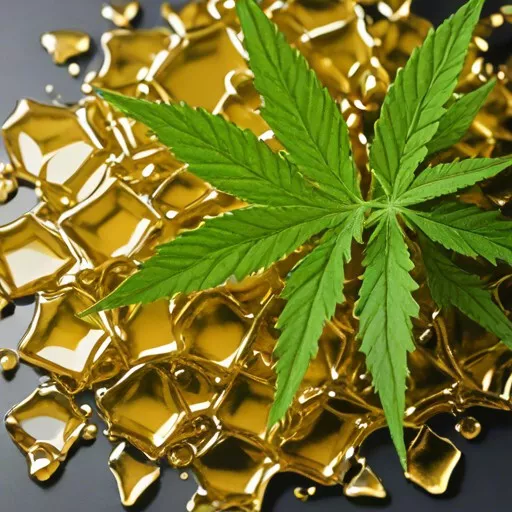
Cannabis leaf symbolizing growth atop golden shatter, representing luxury extract.
Shatter Cannabis
Shatter represents one of the most visually striking cannabis concentrates, characterized by its translucent, glass-like appearance that literally shatters when broken, embodying the pursuit of purity and potency in extraction science. This brittle concentrate typically contains 70-90% cannabinoids in a stable molecular matrix achieved through careful hydrocarbon extraction and purging processes that remove solvents while preserving the rigid structure. The development of shatter marked a significant milestone in cannabis extraction evolution, demonstrating how precise temperature and pressure control during processing could create consistent, shelf-stable products with exceptional clarity and potency that captured consumer imagination and commanded premium prices.
The cultural impact of shatter extends beyond its physical properties to symbolize the modernization and sophistication of cannabis consumption, moving from plant material to refined extracts that emphasize purity and potency. Its distinctive appearance became Instagram-famous, driving social media trends and influencing consumer expectations for concentrate quality based on visual assessment. The term “shatter” entered mainstream cannabis vocabulary as both a product category and quality standard, with clarity and stability becoming benchmarks for extraction excellence. This concentrate type helped establish dabbing culture and drove innovation in consumption devices designed specifically for vaporizing stable extracts at optimal temperatures.
Contemporary perspectives on shatter reflect evolving consumer preferences and scientific understanding, as the market moves beyond simple potency metrics toward full-spectrum products that preserve complete chemical profiles. While shatter’s clarity and stability remain impressive, modern consumers increasingly question whether the processing required to achieve glass-like consistency removes valuable terpenes and minor cannabinoids. This shift has positioned shatter within a broader concentrate ecosystem where different textures serve different consumer needs and preferences. Understanding shatter’s production, characteristics, and market evolution provides insights into cannabis industry maturation and the ongoing balance between purity, potency, and whole-plant preservation.
Production Science
Hydrocarbon extraction methods for shatter production typically utilize butane or propane under precise conditions that selectively dissolve cannabinoids and terpenes while minimizing undesirable compound extraction. Closed-loop extraction systems maintain sub-zero temperatures throughout the process, preventing thermal degradation while ensuring efficient cannabinoid recovery. Material preparation involves freezing cannabis to preserve trichome integrity and reduce chlorophyll extraction that would compromise clarity. Solvent ratios and contact times require careful calibration based on starting material quality and desired end product characteristics. Multiple extraction passes may capture different compound fractions for recombination or separate products. Post-extraction winterization removes plant waxes and lipids essential for achieving shatter’s characteristic transparency. Recovery systems reclaim solvents for reuse while ensuring complete removal from final products. These technical parameters demand sophisticated equipment and expertise differentiating professional operations from dangerous amateur attempts.
Purging protocols transform raw extract into finished shatter through carefully controlled solvent removal that maintains molecular stability while achieving regulatory compliance for residual solvent limits. Initial purging removes bulk solvents through gentle heating under vacuum conditions preventing cannabinoid decarboxylation. Temperature maintenance between 85-110°F proves critical, as excessive heat causes nucleation breaking shatter’s stable structure. Vacuum depth affects purging efficiency and final texture, with deeper vacuums enabling lower temperature processing. Purging duration extends 24-72 hours depending on extract thickness and initial solvent content. Thin film techniques spreading extract maximize surface area for efficient solvent evacuation. Flipping protocols ensure complete purging throughout material thickness. Final vacuum stabilization periods allow molecular arrangement into characteristic rigid matrices. These precise purging requirements distinguish shatter from other concentrate consistencies.
Molecular stability in shatter results from specific arrangements of cannabinoids and residual terpenes forming amorphous solid structures similar to hard candy or glass. THCA molecules in their acidic form create more stable matrices than decarboxylated THC, explaining why shatter maintains consistency better at room temperature. Terpene content must remain low, as these volatile compounds act as solvents preventing stable structure formation. Moisture presence even in trace amounts disrupts molecular arrangements causing cloudiness or sugar crystal formation. Polymorphic forms of cannabinoids arrange differently under various processing conditions affecting final stability. Nucleation sites from contaminants or temperature fluctuations initiate crystallization cascades destroying clarity. Understanding these molecular dynamics enables processors to troubleshoot stability issues and maintain consistent production. This scientific foundation underlies shatter’s unique position among concentrate varieties.
Quality Characteristics
Clarity standards for premium shatter demand complete transparency allowing light transmission without cloudiness, particulates, or color variations that indicate processing flaws or contamination. True clarity results from complete wax and lipid removal during winterization combined with absence of plant particulates from proper filtration. Golden to amber coloration reflects source material quality and processing temperatures, with darker colors suggesting older material or excessive heat exposure. Uniform color throughout indicates consistent extraction and purging without hot spots or incomplete processing. Microscopic examination should reveal no visible contaminants, crystals, or phase separations. Light refraction through quality shatter creates distinctive optical effects demonstrating molecular uniformity. Clarity degradation over time signals improper storage or inherent instability. These visual standards guide both production quality control and consumer purchasing decisions in dispensary settings.
Stability maintenance in shatter requires understanding factors that trigger transformation from glass-like to sugar-like consistencies through nucleation and crystallization processes. Temperature fluctuations represent primary stability threats, with repeated heating and cooling cycles promoting crystal formation. Terpene content above 5% generally prevents stable shatter formation, explaining why terp-rich extracts adopt different consistencies. Contamination from fingerprints, moisture, or particulates creates nucleation sites initiating texture changes. Strain genetics influence stability, with some varieties naturally producing more stable extracts than others. Storage in cool, dark conditions extends stability duration from months to potentially years. Vacuum sealing prevents oxidation and moisture intrusion preserving original consistency. Handling minimization reduces contamination risks maintaining product integrity. These stability factors influence packaging decisions and storage recommendations throughout distribution chains.
Potency profiles in shatter typically show high total cannabinoid concentrations but potentially reduced terpene content compared to other extract consistencies prioritizing flavor preservation. THC percentages commonly range 70-85% with some products exceeding 90% representing near-pure cannabinoid isolation. The pursuit of clarity and stability often sacrifices volatile terpenes reducing strain-specific characteristics. Minor cannabinoid presence varies based on extraction parameters and starting material, with some shatter containing beneficial CBG, CBN, or CBC. Decarboxylation levels affect psychoactivity, with properly made shatter maintaining mostly THCA requiring heat activation. Testing variability across shatter samples proves lower than less homogeneous concentrates due to uniform molecular distribution. Entourage effects may diminish with terpene loss prompting some consumers to prefer less refined alternatives. These potency characteristics position shatter for users prioritizing strength over flavor complexity.
Market Position
Premium pricing strategies for shatter historically reflected production complexity and visual appeal, though market evolution increasingly questions whether clarity justifies cost premiums over terp-rich alternatives. Initial market positioning placed shatter at luxury price points 20-30% above other concentrates based on perceived purity and potency. Consumer education about terpene importance shifted value perceptions favoring full-spectrum products over clarity alone. Price compression resulted as production techniques standardized and competition increased across concentrate categories. Bulk shatter now often prices below live resins or terp sauces despite similar potency levels. Brand differentiation focuses on source material quality and extraction expertise rather than simple clarity metrics. Volume discounts particularly affect shatter pricing as storage stability enables larger purchases. International markets show varying shatter preferences affecting export pricing strategies. These pricing dynamics reflect maturing market understanding of concentrate value propositions.
Consumer demographics for shatter reveal preferences among experienced dabbers valuing potency and clean flavors over newer users potentially overwhelmed by high THC concentrations. Traditional dabbing enthusiasts appreciate shatter’s handling properties and consistent vaporization characteristics. Medical patients seeking maximum cannabinoid delivery with minimal plant material often prefer shatter’s purity. Younger consumers increasingly favor saucier consistencies with stronger flavors over shatter’s subtle profiles. Storage convenience attracts consumers lacking refrigeration for less stable extracts. Price-conscious buyers appreciate shatter’s stability enabling bulk purchases without degradation concerns. Tourist markets show shatter preference for travel durability and discrete appearance. Gender analysis suggests male consumers disproportionately prefer shatter’s technical aspects. These demographic patterns guide product development and marketing strategies.
Competitive landscape positioning of shatter within expanding concentrate categories requires differentiation beyond traditional clarity and potency metrics as consumer sophistication increases. Live resin emergence challenged shatter’s premium status by preserving terpenes sacrificed for stability. Sauce and diamond combinations offer visual appeal rivaling shatter’s clarity with enhanced flavor profiles. Rosin’s solventless appeal attracts health-conscious consumers despite lower clarity than shatter. Distillate cartridges provide convenience shatter cannot match for discrete consumption. Traditional hash resurges among purists valuing whole-plant preparations over isolated extracts. Budget consumers increasingly choose lower-clarity extracts offering similar potency at reduced prices. Innovation in shatter focuses on strain-specific products and terpene reintroduction rather than further purity refinement. These competitive pressures reshape shatter’s market role from dominant premium extract to specific niche serving particular preferences.
Evolution Trends
Terpene reintroduction techniques attempt addressing shatter’s flavor deficiencies by adding cannabis-derived or botanical terpenes post-production, creating hybrid products balancing stability with enhanced profiles. Steam-distilled cannabis terpenes from the same source material provide strain-specific flavors lost during extraction. Botanical terpene blends offer cost-effective flavor enhancement though lacking complete cannabis authenticity. Precise dosing requires understanding how added terpenes affect shatter stability and consistency. Homogenization techniques ensure even terpene distribution preventing separation or clouding. Marketing these enhanced shatters requires transparency about terpene sources and addition methods. Consumer reception varies between appreciation for improved flavors and preference for unmodified products. Price points reflect added processing costs and terpene quality. These enhancement techniques represent shatter evolution responding to market demands for flavorful concentrates.
Nano-technology applications in shatter production explore molecular-level modifications improving bioavailability, stability, and consumption experiences through advanced material science. Nano-emulsification could create water-compatible shatter particles for beverage applications. Encapsulation technologies might protect shatter from degradation while enabling controlled release properties. Crystalline engineering at nanoscale could enhance structural stability preventing unwanted nucleation. Surface modifications using nano-coatings could prevent oxidation extending shelf life. Bioavailability enhancement through particle size reduction could reduce required doses maintaining effects. Research into nano-structured cannabinoid arrangements might create novel properties beyond current capabilities. Regulatory frameworks struggle addressing nano-modified cannabis products requiring new safety assessments. Commercial viability depends on cost-effective scaling and consumer acceptance of high-tech modifications. These frontier technologies suggest shatter’s potential evolution beyond current forms.
Market predictions for shatter suggest stabilization as mature product category serving specific consumer segments while innovation focuses elsewhere in concentrate development. Production automation reduces costs potentially positioning shatter as mid-tier rather than premium option. Quality standardization eliminates significant differentiation between competent producers commoditizing basic shatter. Niche markets develop for exotic starting materials or specialized processing techniques maintaining some premium segments. Export opportunities exist where regulations favor stable, testable products over volatile alternatives. Vertical integration advantages manufacturers controlling seed-to-shatter supply chains ensuring quality. Consumer education continues shifting preferences toward full-spectrum options limiting shatter growth. Medical applications may expand appreciating consistent dosing from stable products. Technological disruptions could revitalize category through novel modifications. These projections position shatter as established but evolving concentrate category adapting to changing market demands.